Remembering the Gatwick–Heathrow Airlink
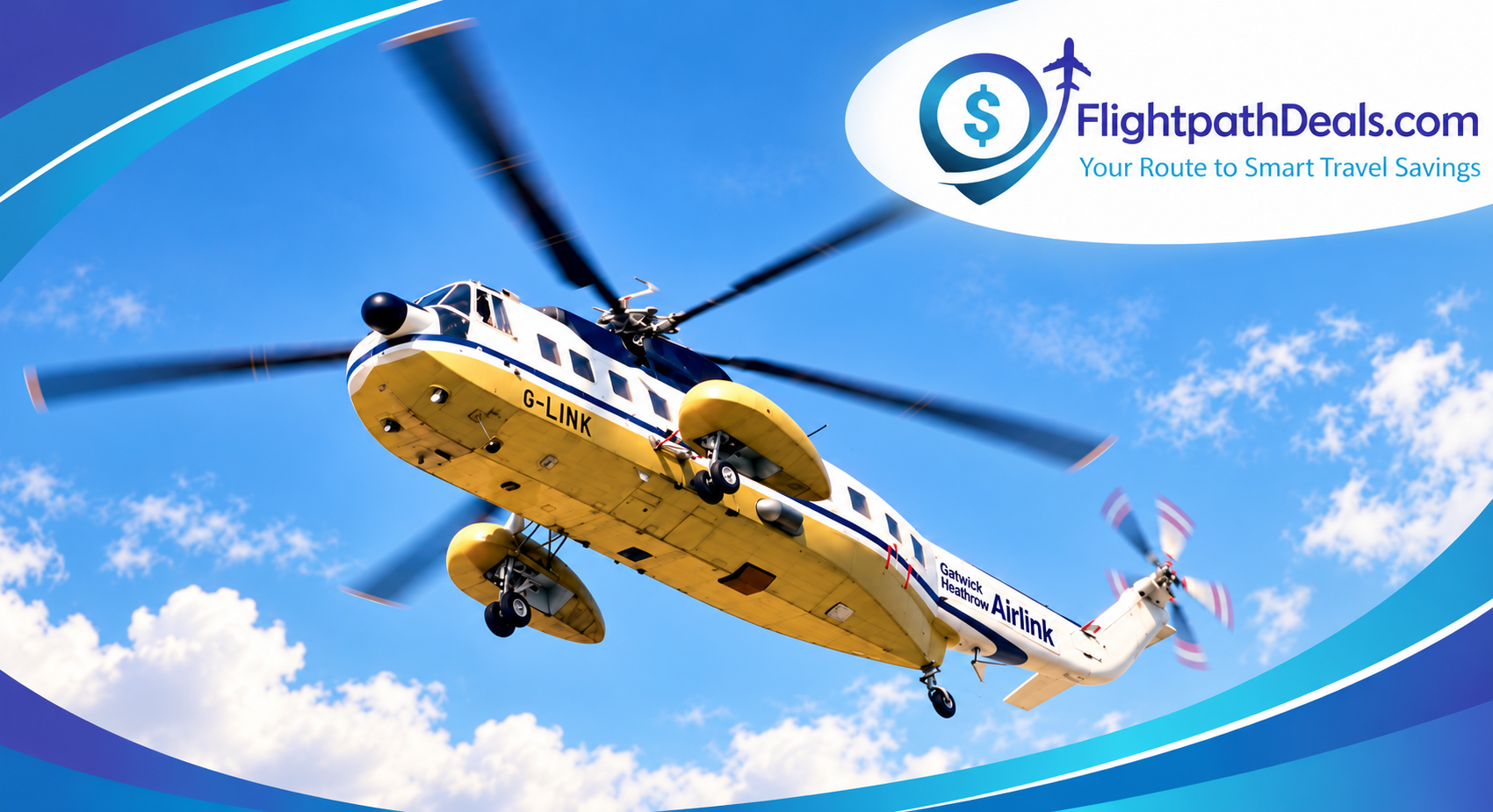
Remembering the Gatwick – Heathrow Airlink
When You Could Transfer by Helicopter
Imagine arriving at Gatwick Airport and discovering that your connecting flight leaves from Heathrow. Instead of boarding a coach or sitting in motorway traffic, you climb aboard a large Sikorsky helicopter. For eight remarkable years, passengers could genuinely do exactly that.
Between 1978 and 1986, the Gatwick–Heathrow Airlink carried passengers between London’s two major airports aboard a Sikorsky S-61N helicopter. Its registration could hardly have suited the service better: G-LINK. The service began on 9 June 1978, when the then Prince of Wales travelled on the inaugural flight from Gatwick to Heathrow.
Today, travelling between Gatwick and Heathrow can still involve a lengthy road journey. The idea of simply taking a helicopter now feels wonderfully extravagant.
Why Did the Airlink Begin?
Gatwick grew rapidly during the 1970s. However, Heathrow remained London’s dominant international hub and offered far more connecting flights. This created a problem. Passengers arriving at Gatwick sometimes needed to catch another flight from Heathrow, yet no motorway connection comparable with today’s M25 existed.
The Airlink aimed to make Gatwick and Heathrow operate almost like one enormous airport. British Caledonian Airways, British Airways Helicopters and the British Airports Authority worked together to run the service. The British Airports Authority owned the main aircraft, the 28-seat Sikorsky S-61N G-LINK. British Caledonian managed much of the commercial operation and cabin service, while British Airways Helicopters initially provided the pilots, maintenance and technical support.
Ten Return Flights Every Day
At its height, G-LINK operated as many as 10 return journeys each day. During busy periods, the helicopter could leave Gatwick approximately every 50 minutes. Ground crews handled passengers and baggage quickly, while the helicopter often kept its engines and rotors running during the turnaround.
Once operators streamlined the service, the flight took around 15 minutes. Compare that with an hour or more on the road and the appeal becomes easy to understand.
Where Did the Helicopter Leave From?
Gatwick gave Airlink a particularly distinctive operation. Historical records show that passengers used Gate 1H and Stand 1 beside Gatwick’s old South Pier. G-LINK had exclusive use of Stand 1, which sat only a few hundred yards from the British Airways Helicopters base.
Heathrow also provided a dedicated Airlink stand and passenger facilities. British Airways handled passengers there. Period photographs and aviation recollections place G-LINK around the Terminal 2 area, although surviving sources give less detail about the exact gate than they do at Gatwick.
Passengers therefore did not simply arrive at some remote helipad. The airports incorporated Airlink into the wider passenger transfer operation.
How Much Did It Cost?
When Airlink began in 1978, a one-way journey cost £12, while children paid half fare. That £12 may sound incredibly cheap today, but it represented a significant amount at the time. Allowing for inflation, £12 in 1978 equates to roughly £89 in 2026 purchasing power.
By the final years of operation, a one-way ticket reportedly cost around £21. In 2026 money, £21 from 1986 represents approximately £80 in purchasing power.
Airlink therefore offered a premium airport transfer rather than a bargain option. Passengers paid for one major benefit: time.
What Was It Like to Fly on G-LINK?
The Sikorsky S-61 was a substantial helicopter. It looked very different from the small executive helicopters many travellers might picture today. Its large passenger cabin, twin engines and distinctive boat-like fuselage made it well suited to scheduled passenger services.
G-LINK originally carried up to 28 passengers. Operators later lowered the passenger capacity to create more room for baggage. The experience must have felt completely different from taking an airport coach.
Passengers experienced the noise and vibration of the huge rotor overhead, views across southern England and the extraordinary novelty of flying directly between two of the world’s busiest airports.
Even the ground operation created a sense of adventure. Contemporary accounts describe passengers boarding while the rotors continued turning. It must have felt more like the start of an expedition than a simple airport transfer.
G-LINK Became an Aviation Celebrity
The registration G-LINK became almost as memorable as the service itself. Its distinctive Airlink colours and enormous Sikorsky silhouette made it instantly recognisable at Gatwick and Heathrow.
Aviation photographers regularly captured the helicopter arriving, departing and operating among conventional airliners. For enthusiasts who remember British Caledonian, G-LINK now represents a very different period in British commercial aviation.
Air travel during the late 1970s and early 1980s still produced ideas that seem remarkably adventurous today.
So Why Did the Helicopter Service End?
Ironically, another airline did not bring down Airlink. The M25 motorway played a much bigger role.
Authorities linked the helicopter’s licence closely to completion of the motorway connection between the areas surrounding Heathrow and Gatwick. In 1984, the Government directed the licence to end four months after the relevant section of the M25 opened.
Noise also caused major problems. Communities beneath the flight path complained about disturbance, and the service became politically controversial. Parliament discussed the environmental impact extensively.
G-LINK flew its final Airlink service on 6 February 1986. British Caledonian hoped to restart the operation, but in June 1986 the Government instructed the Civil Aviation Authority not to approve its return.
The Government argued that alternative surface transport now existed and no longer justified the environmental disturbance created by the helicopter.
And just like that, one of Britain’s most unusual scheduled air services disappeared.
Could a Gatwick–Heathrow Airlink Ever Return?
It is fascinating to imagine how a modern version might look. Companies around the world continue to develop electric vertical take-off aircraft and other forms of advanced air mobility.
Aviation industry discussions about future urban air transport have even looked back at the Gatwick–Heathrow Airlink as an early example of scheduled aerial travel between major airports.
Whether today’s travellers would accept the noise, cost and environmental concerns surrounding a helicopter-style shuttle remains another question.
However, the original Airlink proved one important point. Travellers wanted a fast connection between Heathrow and Gatwick. Almost half a century later, that challenge has not entirely disappeared.
A Wonderful Memory From a Different Age of Aviation
The Gatwick–Heathrow Airlink lasted less than eight years, yet it remains one of the most fascinating chapters in London’s aviation history.
One dedicated helicopter. Ten return services per day. A 15-minute flight. British Caledonian and British Airways working together. And perhaps the perfect registration for the job: G-LINK.
For thousands of passengers, changing airports did not simply form part of the journey.
It became a flight in itself.
Search for the Best deals on Flights
Search for the Best Hotel rates with up to 60% Discount
airline nostalgia airport transfers aviation history aviation memories British Airways Helicopters British Caledonian classic aviation FlightpathDeals G-LINK Gatwick Airport Gatwick Heathrow Airlink Heathrow Airport helicopter travel London airports Sikorsky S61


One Response
i never got to fly on it but i remember seeing it and thinking wow that would have been amazing, shame it was stopped